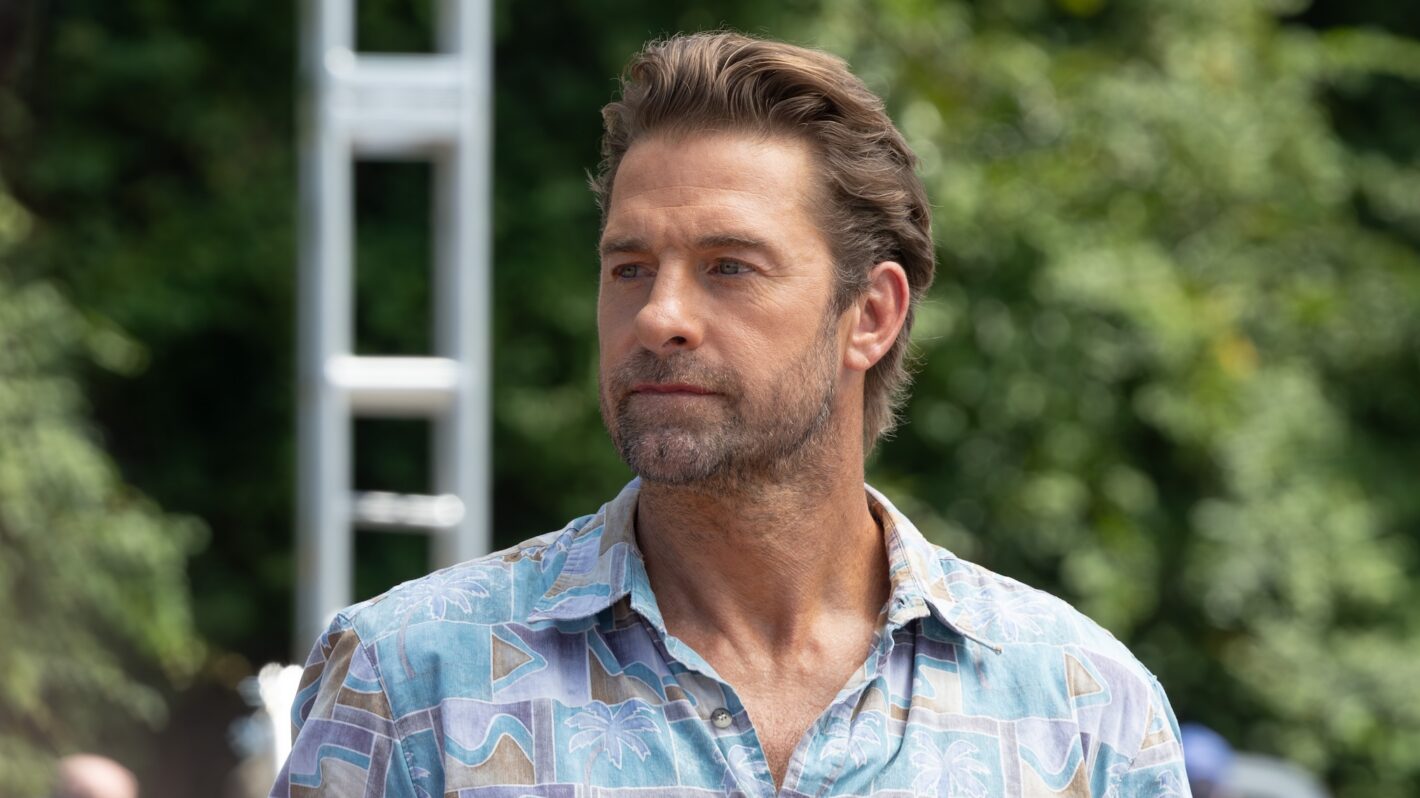
The following post contains SPOILERS for You Can See Everything. It really is best to go into the film knowing nothing about it. You don’t want to know everything before you see You Can See Everything.
The title of Nathan Fielder and Lance Oppenheim’s You Can See Everything is taken from a text message sent to Fielder by one of the documentary’s subjects: Disgraced entrepreneur, former billionaire, and current inmate of the Federal Prison Camp in Bryan, Texas Elizabeth Holmes. In the days prior to Holmes’ incarceration, she and her partner, Billy Evans, invited Fielder and Oppenheim to document every aspect of their lives.
Fielder is understandably skeptical of Holmes, who was convicted of multiple counts of fraud as a result of her actions as the founder of Theranos, which claimed to have created a groundbreaking device that could perform countless tests on a single drop of blood. Holmes continues to insist she is innocent, and tells Fielder she has nothing to hide. She invites him to live in her guest house for the duration of the documentary. He remains wary. While she’s walking on the beach with Evans and their children, she texts Fielder “You can totally see everything.”
Fielder and Oppenheim removed the ‘totally’ to create the name of their documentary, which is already one of the most-discussed films of 2026. The title carries layers of meaning; among other things, it’s a very dry joke about the fact that Fielder and Oppenheim’s all-access approach yields footage that includes full frontal nudity of Evans while he’s in the shower. More importantly, Holmes’ text to Fielder contains the single most important word in the entire film, the one that’s central to understanding her and this strange and fascinating movie: Can.

READ MORE: Hollywood, Please Bring Back Making-Of Documentaries
That becomes clear when Holmes digs out the remains of the notorious Edison, Theranos’ all-in-one blood testing device, and tries to explain to Fielder why she is not guilty of defrauding investors and deceiving the public. Holmes’ defense largely comes down to a matter of semantics. She said that the Edison “can” perform all manner of blood tests. “Can” — as in the device was programmable to do all kinds of test. Was it capable of performing all the tests it could theoretically do? No. It was not capable — yet. But it could be capable, eventually, with further advancements in chemistry and technology.
It seems entirely reasonable for someone who heard the sentence “This device can perform many different blood tests” to assume that it works — not that it is technically capable with more time and development. Viewers (and Theranos investors) might see Holmes’ argument as an evasion; an attempt to locate a legal loophole in her sworn testimony akin to when Bill Clinton told a grand jury “it depends on what the meaning of the word is is” when trying to claim he did not have “sexual relations” with Monica Lewinsky.
But Fielder’s footage of Holmes — in which she permits him to totally see everything about her life — invites at least the possibility that Holmes’ brain works so differently than other people that maybe she really did believe that these seemingly very false statements were, from her perspective, accurate. In one of You Can See Everything’s most spellbinding scenes, Fielder shows Holmes Abbott and Costello’s famous “Who’s on First?” comedy routine. Holmes doesn’t laugh.

Afterwards, Fielder asks Holmes to explain why the routine is funny. She can’t. (Or maybe she would say she can, she’s just not capable of explaining at this exact moment why it is funny.) She claims not to comprehend the confusion at the heart of the joke. She can’t even tell Fielder the name of the guy on first base. (“I didn’t catch it,” she says.) If someone could miss the point of “Who’s on First?” this badly, could they also miscommunicate their intentions with a medical device so badly they wound up in prison for 11 years?
It’s a stretch — but Fielder’s film at least leaves open the possibility that’s what transpired. And that possibility is what You Can See Everything is all about. After Holmes surrenders to authorities in Texas, them film resumes two years later, with Fielder still lost in a fog of uncertainty about his elusive subject. He begins following Evans again, and discovers he’s trying to resurrect the Edison in her absence.
He’s also aligned himself with some seemingly shady people, and frequently tweets from Holmes’ verified X account without her knowledge, and in ways that sound nothing like her. When Fielder questions Evans’ decisions, he insists he knows Holmes well enough to make decisions on her behalf — and anyway he has full power of attorney to do whatever he wants in Holmes’ name.
Holmes’ other defense during her trial was that she was deceived and manipulated herself by Theranos’ president Sunny Balwani, who was also her romantic partner at the time. (She also alleged that he sexually abused her, something Balwani denied.) If Holmes could be manipulated by one powerful man, is it possible that same cycle is repeating itself all over again? Fielder tries to maneuver around Evans to speak directly to Holmes in prison — not an easy task, given Evans’ protective attitude towards her, and the strict rules governing interactions with federal prisoners.

Fielder also enlists actress Amanda Seyfried to recreate her Emmy Award-winning performance as Holmes from the Hulu series The Dropout in new reenactments for his film; Seyfried plays Holmes in scenes between her and Fielder where cameras are not able to be present. (Seyfrield also plays herself reacting to Holmes’ statements about her case — and about Seyfried’s portrayal of her — in meta scenes interspersed with the reenactments.) Fielder wants a smoking gun that will prove one way or another whether Holmes is a master manipulator or a victim of manipulative men. He finds only vapor, and even more enigmatic statements from Holmes. (When Seyfried joins Fielder on a visit to Evans, and Holmes from prison, Seyfried asks her if she knew that she’d be there when she called. Her enigmatic response is something along the lines of “I’m not sure if I knew.”)
The ultimate futility of Fielder’s quest reinforces the brilliance of the title, along with the central thesis of You Can See Everything. The movie is about how even when a documentarian can see everything, even when their subject claims to offer complete transparency, the filmmakers are still not capable of getting to the absolute truth of anything — if such a thing exists at all.
25 Movies With Surprising Letterboxd Scores
Sometimes consensus about a work of art is not what you expect it to be, especially on a site like Letterboxd, which aggregates the movie ratings and reviews of thousands of users.