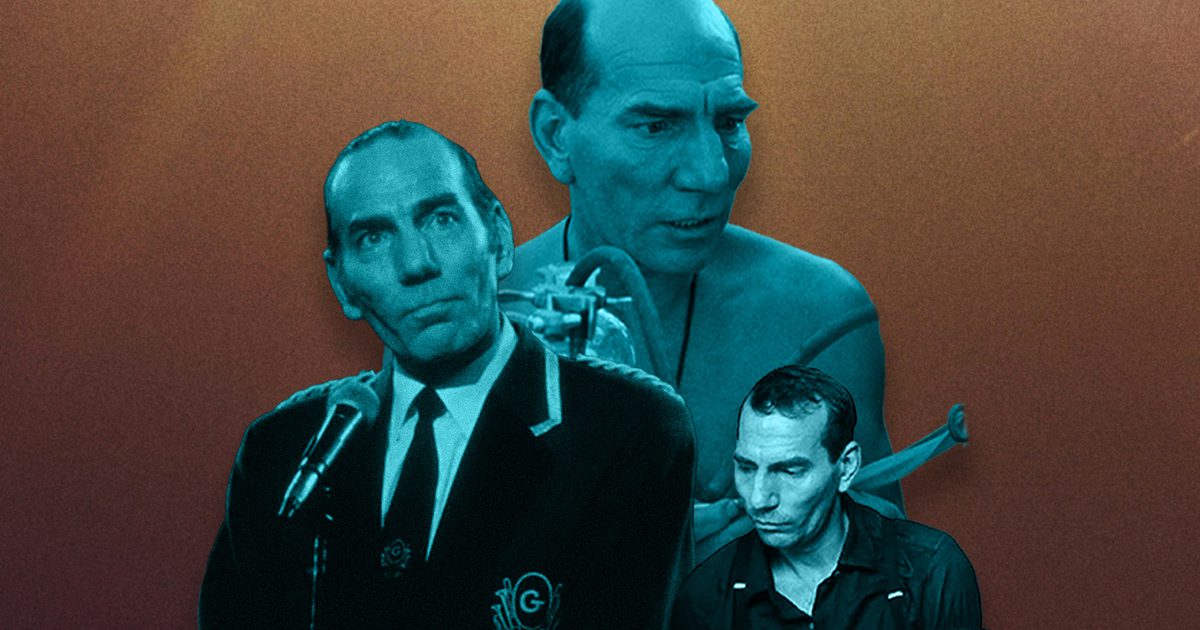
“The truth is, Ithought it mattered,” remarks Pete Postlethwaite’s Danny Ormondroyd, impassioned to give arousing defence of his community in the moving finale of Mark Herman’s Brassed Off(1996).“I thought that music mattered. But does it bollocks? Not compared to how people matter,” he continues. Danny leads acolliery band in the fictional Yorkshire town of Grimley, where the local coal pit is under threat of closure, leaving acommunity on the brink. Danny is steered by aset of unequivocal principals. Amidst financial hardship, he expects his horn players, trombonists and percussionists to pay their monthly dues, and holds aresolute conviction that the band will save the pit, guide the community out of obsolescence and slay the Thatcherite dragon. Like many of Postlethwaite’s protagonists, Danny is guided by abelief in something greater than himself. It’s all aquestion offaith.
As aboy in his hometown of Warrington, Postlethwaite’s path to faith appeared more direct, his working class Catholic roots inspiring visions of ministry. Though he dropped out of the seminary, it left an indelible mark on the man. After ashort stint teaching drama and astoried career on stage, he was 42 when he finally came to wider acclaim with the release of Terence Davies’ 1988Distant Voices, Still Lives. Embodying the rageful patriarch in Davies’ mesmerisingly redolent family album of violence, love and repression, Postlethwaite taps into auniquely Old Testament sort of wrath. We’re introduced to him not by way of his auspiciously distinct face, but through his legs. Maisie (Lorraine Ashbourne), the middle child of the family, is on her knees, scrubbing abasement floor, when she asks her Father for afew bob to go dancing. Davies elects to keep his camera low, staying with the daughter, while we only see Postlewaite’s bottom half – afaceless dictator ruling above her. Acouple of coins trickle down on the girl from above, areprieve of throwaway mercy, before Father rains fire and brimstone on her via abeating with abroomstick.
Get more Little WhiteLies
There’s doubtlessly afatherly thread through Postlethwaite’s oeuvre. Similar to his patriarch inDistant Voices, Still Lives,his absent billionaire dad Maurice Fischer in Christopher Nolan’sInception,and even Danny inBrassed Off, whose musical obsession threatens near-fatal consequences for his own son, Postlethwaite’s most memorable performances are often defined by relationships to their children. It was atheme the actor felt ambivalent about: “the theories were neat, but Ididn’t buy them,” he posits in his autobiography. It’d be difficult to disagree with Postlethwaite: there are shades to his patriarchs.
His portrayal of adevoted Dad in Jim Sheridan’s 1993 filmIn The Name of the Fatheris acase in point: Guiseppe Conlon is all about conviction. Wrongly imprisoned for arole in the 1974 IRA bombing of aGuildford pub, Guiseppe is subjected to the shadowy ills of the British deep state and locked up for nearly five years before passing away in his own jail cell. In defiance of his failing health, he spends his years in the nick scurrying up and down stairs to the prison’s postroom, scribbling letters of his innocence to those brave enough to listen. Despite being subject to one of the 20th century’s gravest injustices, Postlethwaite’s Guiseppe retains an inscrutable faith that the British legal system will right its wrongs and one day set himfree.
It’s afaith in love and reconciliation that guides Postlethwaite’s Friar Lawrence in Baz Luhrmann’s 1996 gaudy modern retread of Shakespeare inRomeo + Juliet, where the actor’s preteen seminary dream finally comes to fruition. With aceltic cross tattoo etched into his bronzed back, we initially happen upon Lawrence as he knocks back athimble full of some hyper-cyan coloured spirit and dabbles in aspot of horticulture. Luhrmann’s Verona is alurid and tempestuous place in which intensity of feeling rules the day. While inDistant Voices, Still Lives, Postlethwaite’s furrowed features project amaniacal severity, here that same face imbues aprofound warmth; an unshowy magic in his demeanor that brings asteadfast and even-tempered idealism to the chaos. Lawrence’s desire for peace by uniting the houses of Montague and Capulet anchors reality to the feverish alien world these characters inhabit. Amdist star-making turns, it’s Postlethwaite’s fatherly friar that instills heart and empathy.