When I open up TikTok to start my nightly scroll, I’m met with a video of a woman musing about Iris Law’s style. “The through line is just that she likes each thing she’s wearing. … She did not think, ‘Is everyone gonna like this?’” the creator explains. “She thought, ‘I want to feel fun and good.’” In the video, images of Law’s outfits rotate across my screen: a pair of ruffled bloomer shorts married to a striped Adidas top, collegiate sweatpants with a military-inspired jacket and jelly flats, an orange T-shirt with sequin boxer shorts. It’s true. The through line is that there is no through line. For the 25-year-old model and founder of Japanese tea brand Little Sip, it’s simply about wearing individual pieces that seem to bring her joy.

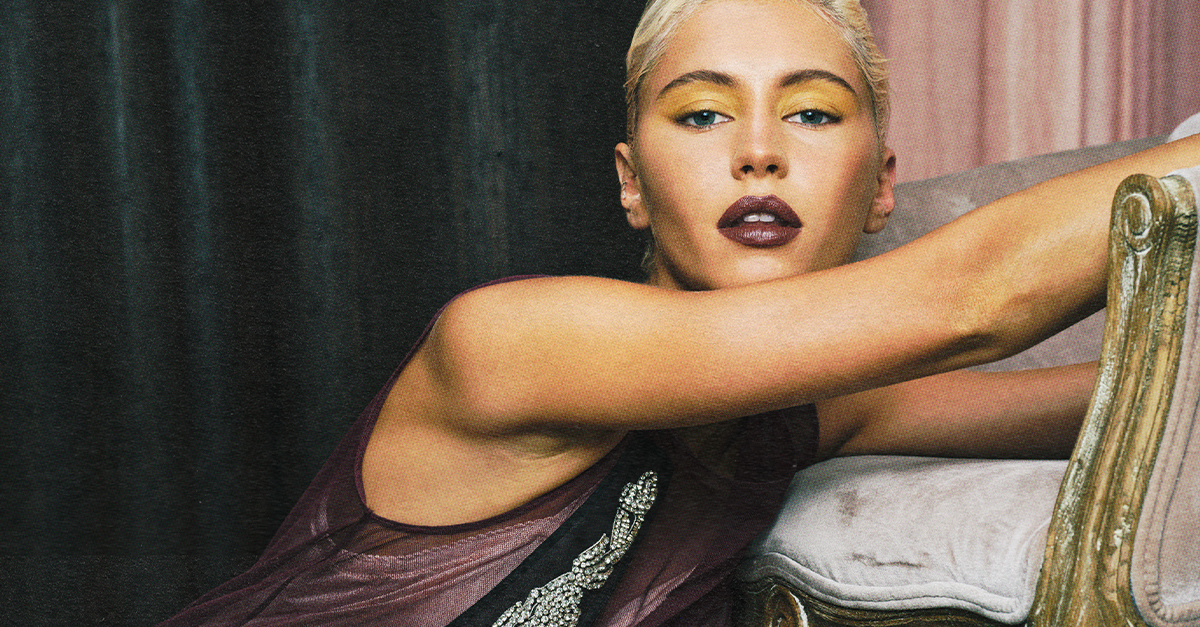
This playfulness, levity, and childlike sense of awe is the idea I hold in my mind when I go to meet with Law. When she arrives to greet me at the Bowery Hotel the day before our cover shoot, she’s not the perfectly manicured person from the Fendi campaign that dropped just days prior. She’s the undone, “just dressed for herself” version of the woman in the TikTok video. Law plops herself down on the armchair opposite me and immediately takes her shoes off, curling her knees underneath her and making herself right at home. She’s all ease and effortlessness in a slinky scoop-neck tank and drawstring basketball shorts, her platinum pixie cut held in place by a single snap clip.

“My friends kept sending me the video,” she laughs when we broach the topic. “I really agreed with her.” She quickly adds, “Not the bit of her bigging me up or whatever but what was said. I genuinely pick up clothes and [reach for] whatever makes me feel happy.” It would be easy for someone like Law to become hyperaware of how she’s perceived. She’s spent a decade in the spotlight, fronting campaigns for luxury labels such as Miu Miu, Burberry, and Fendi. Over 800,000 people follow her on Instagram, and she had a similar number on TikTok before she deleted her page. She gets photographed nearly every time she steps outside, and her outfits inspire a myriad of headlines about the next It item or cool-girl trend. She’s recently added founder to her résumé with the launch of Little Sip. Anyone else in her position might begin to self-edit, knowing their appearance will be analyzed and picked apart, but not Law. “I won’t sacrifice my comfort for fashion anymore,” she insists, explaining that ever since she was younger, her sensitivity toward certain fabrics and fits has been heightened. “I just want to express my personality. I don’t want to adhere to a trend.”

Her refusal to be neatly packaged—instead following her instinct above all else—has made Law into something of a prototype for the It girl of her generation. “I’ll just get obsessed with something and then just start doing it. It’s almost childlike,” she tells me when I dig into where her style references originate. “My friend was wearing these purple basketball shorts, and I just looked at him and thought to myself, ‘You’re going to be obsessed with purple now.’” I’m quickly coming to learn that inspiration can come from almost anywhere for Law, but staying loyal to her taste, despite often being ahead of the curve, is a constant negotiation for her. “I don’t like polka dots anymore, and I’m trying to say, ‘Who cares if polka dots are in trend right now or were in trend last year? You like polka dots, so wear them.’ But I can’t,” she admits. “I packed this polka-dot bikini on holiday, and anytime I went to wear it, I was like, ‘This isn’t a representation of who you are because it looks like you’re trying to do something because everyone else is doing it.’ A lot has been ruined for me.” It’s an occupational hazard: The minute she likes something, it stops belonging only to her.

If it’s true that how you do one thing is how you do anything, then I’m quickly seeing how that negotiation with herself is Law’s modus operandi. It’s a constant conversation between her instincts and any external pressure—be it around the “right” career path, the fashion trends of the moment, or a perfectly curated image online.
Case in point: She’s recently decided to take a step back from TikTok despite her overwhelming success on the platform. “None of my close, close friends who I speak to daily are on social media,” she says. “So it alienated me in that way. I [realized I was] caring about things that the people around me don’t really care about.” For someone who basically grew up both online and in the public eye (her modeling career began at the age of 15), Law remains remarkably grounded.

It’s not a clean break, she clarifies. Rather, it’s a decision to emotionally disconnect from the near-parasocial dynamic with her audience. She’s careful not to frame it as some dramatic rejection of the internet altogether, emphasizing a growing anxiety that no volume of posts could quell. “I started getting this panic where I was like, ‘People don’t understand me.’ What I choose to post is fun and playful because that’s how I chose to post, and I’ve been posting since I was young,” she says. There’s an exhaustion underneath that too, and it speaks to a broader fatigue among her peers, who are expected to somehow be everything to everyone all at once. “It’s very tiring to show that you study and you read and you also have fun and you also like snacks,” she says. “I don’t want to put hours and hours of work into my phone to show every part of myself.” Despite her sunny disposition, I detect a hint of defeat in her tone.
It’s a sentiment that any creative person is all too familiar with: the perfection paralysis. It’s the fear that keeps so many of us from doing, speaking, and creating for fear of showing up less than flawlessly, and for Law, it’s not just about her social media presence. It also includes projects like Little Sip, the brand she founded that centers Japanese teas. For Law, it was never going to be a simple licensing deal or her name attached to someone else’s product. It needed to mean something.

“It’s been years of people telling me that [I should start a tea company], and I kept saying, ‘There are people who know more than me. I want to know enough to feel like I’m valid in this space,’” she explains. “The world of tea… People really master the craft over hundreds of years of history, and I wanted to actually learn, not just do it. Why would I sell tea if I don’t know everything yet? What is my purpose in that?”
After many, many trips to Japan, including one three-month stint to learn the language, Law felt confident enough in her knowledge of tea to turn it into a real venture. She says, “Going there, I just felt like, wow, seasonal eating, living closer to the land—I found a world that embodies how I like to live.” She tells me that the ceremony and ritual around Japanese tea culture have informed her approach to building a brand. “It kind of embodies my feeling toward Japan,” she continues, citing the work of Shigeru Uchida, “of doing things with purpose and not adding to the bullshit.”

These days, it seems like the pretext for being considered a celebrity means shilling a product (or several), whether that means fronting a campaign or putting your own name on the label. But there’s another layer to it: the question every famous parent’s child eventually has to answer out loud. Did she earn the space she takes up? Law doesn’t dodge it. “I don’t want to embody a space that I haven’t mastered. If I’m putting my identity on something, I want to feel like I deserve that title,” she insists. It’s the same logic that kept Little Sip in development for years longer than it might have taken someone less careful. “Now, I really want to show people what I’ve learned, and it’s just fun and exciting. There are other places in my life where I feel the same, and right now, I just want to privately do it and figure it out myself,” she continues.
The next venture she’s privately working toward? Acting. She’s careful, almost superstitious, about how she presents the information. “In the next five years, I would like to go further into acting,” she says in response when I ask about what the future could hold for her career. “But right now, to just whimsically say it feels scary because I’m working hard.” At the moment, that means doing a lot of self-tapes, taking meetings with industry insiders, and—true to form—building a self-designed education in the process. “I want to feel like I really have deserved whatever comes my way,” she says.

“I really enjoy the process of meeting with directors,” Law adds. “My favorite part, even if I’m not getting the role, is doing the research behind the people. Say it’s a biopic. It feels like prescribed learning—watching all of the films of one director or a documentary about the person they’re trying to make a film about.” But when I ask about what she’s auditioning for the most right now, I’m surprised to hear her answer is horror. It’s ironic, she admits, for someone so scared of horror to film herself, but “there are so many amazing directors now going into horror and incredible horror coming out,” she explains. “It’s a growing genre.”
It’s a habit she applies across every new pursuit, I’m realizing. Being on set, surrounded by people whom she’d long looked up to, was something Law found incredibly humbling when she first entered the modeling space. Getting to collaborate with the very names she once studied? Priceless. To understand it, she takes me back to the wide-eyed 15-year-old who landed her first big fashion job: a Miu Miu campaign styled by Katie Grand, the legendary former editor of Love magazine, whom Law had idolized.

“I remember doing [that Miu Miu campaign] and her asking me one or two questions. I was so young, and she’s asking me ‘Do you think this bag goes with this hat?’ and the feeling of my heart racing and being like, ‘Is there a right answer?’ and seeing that shoot and thinking, ‘Whoa, I’m now part of something that I was using as inspiration in my essays in school, working with brands or designers that I did heavy research on for my fashion degree,’” she recalls. It was all very full circle for a young Law, the ultimate affirmation of her taste and instincts.
Grand became something of a recurring figure in Law’s early career—part mentor, part proof that the industry she’d studied from a distance was real and reachable. “I’d say Grand choosing me for things,” she answers when I ask about her first aha moments, “and doing Burberry Beauty, which was amazing because I’m British, and it just felt so right. Burberry was so iconic to me growing up. I just grew up watching Love magazine videos, and I couldn’t believe it. And then I’m on set with Grand. It was just incredible.”

Usually, it’s impossible to fully grasp the significance of the moment you’re in while you’re still in it, but even at such a young age, Law seemed to possess a certain precociousness. “I knew a lot about and had a lot of passion for brands and magazines at such a young age,” she remembers. “It meant that I understood what I was doing, even though I was young. I knew who I was working with and felt the weight of it.”
A decade into modeling, that weight hasn’t lifted, nor is it likely to. She’s no less set on proving herself, even with a résumé that spans Versace, Burberry, and Victoria’s Secret runways and campaigns for Miu Miu, David Yurman, and Marc Jacobs. “I think you should always feel like [you need to prove yourself],” she argues. “I don’t think you should get complacent in the place that you’re in.” It’s not naïveté but not guilt or entitlement either. “It’s about being aware of any privilege that I hold and being kind and working hard,” she insists. “You can get sucked into a negative way to think about it. I try to take the positive route of feeling like ‘Wow, I’m so lucky’ and understand that, of course, there are privileges that I hold.”

Doing her homework. Working hard. Following her instincts. Moving slowly, deliberately, and never before she’s ready. It’s an unusually disciplined approach for someone who came of age inside an industry built for constant visibility, but it may be exactly what makes her a credible blueprint for the next 20 years of It-girlhood. She’s not necessarily a face attached to a trend cycle; she’s a multifaceted person building a body of work—one intentional, passion-driven, and well-researched project at a time.
As for where she goes from here, Law isn’t in any kind of rush to say. She’s quietly doing her acting tapes. She’s formulating her next tea pop-up. She’s still, by her own admission, figuring a lot of it out privately, on her own timeline. But if the last decade is any indication, Law is betting on the slow build, and so far, she’s winning.
Photographer: Richie Talboy
Stylist: Ana Tess
Editor in Chief: Kat Collings
Creative Director: Natalia Sztyk
VP of Creative: Alexa Wiley
Hairstylist: Takuya Yamaguchi
Makeup Artist: Sasha Borax
Manicurist: Jazz Style
Set Designer: Lane Vineyard
Entertainment Director: Jessica Baker
Producer: Lindsay Ferro
DP: Gabe Harden
Explore More: